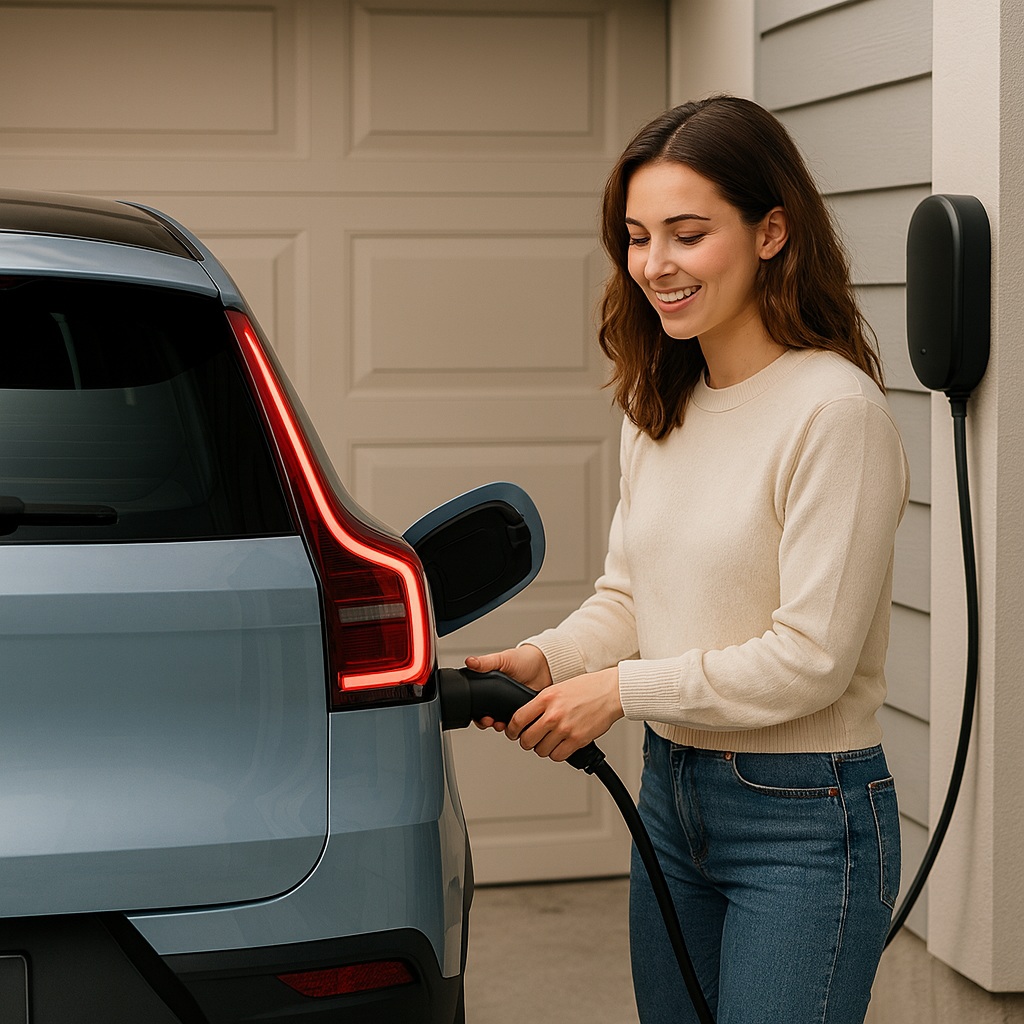

The short answer Most home charging is completed comfortably overnight because the car is not empty when it arrives. Divide the energy that must be replaced by the actual charging power, then add a sensible allowance for losses and variation.
Battery capacity alone does not tell you the normal charging time. A 60 kWh battery driven from 70% to 50% needs only about 12 kWh returned to the battery, not a full 60 kWh recharge.
Use the energy to add, not only the battery size
The basic planning calculation is: charging time in hours ≈ energy to add in kWh ÷ actual charging power in kW. Because some energy is lost in the cable, vehicle electronics, battery conditioning and conversion, the wall must normally supply more energy than the battery gains.
For a simple estimate, add roughly 10% to 20% to the battery energy required. The exact loss is vehicle-specific and can change with power level, temperature and auxiliary loads. A charger’s energy reading and the vehicle’s displayed battery increase will therefore not always match exactly.
Typical home charging times
| Battery energy to add | 2.3 kW portable | 3.6 kW wallbox | 7.4 kW wallbox | 11 kW wallbox |
|---|---|---|---|---|
| 10 kWh | about 5 h | about 3 h 20 min | about 1 h 40 min | about 1 h 10 min |
| 20 kWh | about 10 h | about 6 h 40 min | about 3 h 10 min | about 2 h 10 min |
| 40 kWh | about 20 h | about 13 h | about 6 h 20 min | about 4 h 20 min |
| 60 kWh | about 29 h | about 19 h 30 min | about 9 h 30 min | about 6 h 30 min |
The estimates include a modest loss allowance. They assume the car accepts the stated rate. A vehicle limited to 7.4 kW will not use 11 kW merely because it is connected to an 11 kW wallbox.
A real daily-use example
Assume an EV consumes 18 kWh per 100 km and travels 55 km in a normal day. The battery has used about 9.9 kWh. Allowing for charging losses, the wall may need to deliver roughly 11 to 12 kWh.
| Available charging power | Approximate time to replace the day’s energy |
|---|---|
| 2.3 kW | about 5 hours |
| 3.6 kW | about 3 hours 20 minutes |
| 7.4 kW | about 1 hour 35 minutes |
| 11 kW | about 1 hour 5 minutes |
Even the lower-power options may finish within a long overnight window. The advantage of the higher-power wallbox is greater flexibility after a long trip, between two vehicles or when charging must fit into a shorter solar or tariff window.
What limits the actual charging power
- The vehicle’s maximum AC onboard-charger rating and whether it accepts one or three phases.
- The property’s phase supply, circuit rating and commissioned current limit.
- Dynamic load management reducing power while other household loads are high.
- The vehicle’s charge schedule, target state of charge and battery temperature.
- Voltage variation, charging cable limits and the charger’s own settings.
- Solar-surplus mode varying the current as generation and household demand change.
Why the final part of charging may behave differently
AC home charging often remains fairly steady, but the vehicle can still reduce power near the selected limit, during battery balancing, in temperature extremes or while running battery conditioning. The dashboard’s time estimate may change during the session.
Should you charge to 100 percent every night
That depends on the vehicle and battery chemistry. Many owners set a daily limit below 100% and charge higher only when the next trip requires it; some manufacturers give different advice for particular battery types. Follow the exact vehicle manual and app guidance. The charging-time calculation should use the target you actually plan to reach.
Portable charging needs extra caution
A portable charger at 10 A can be useful for occasional or low-mileage charging, but it runs an ordinary socket and its connections under sustained load for many hours. The socket, circuit and protective devices must be suitable. An extension lead or worn socket is not a safe shortcut to a wallbox installation.
How load management affects the estimate
A dynamically managed charger does not always run at its maximum. If the home becomes busy, it reduces EV current and the session takes longer. That is a designed trade-off: the car uses spare capacity without overloading the supply. A useful estimate should consider the likely overnight base load, not only the wallbox label.
A better way to choose charger size
- Estimate normal kilometres driven per day.
- Multiply by realistic vehicle consumption in kWh per 100 km.
- Add an allowance for charging losses.
- Divide by the reliable charging window.
- Confirm the vehicle and property can support the resulting power.
- Allow for occasional long days without designing every decision around a completely empty battery.
Talk to NevGridSolutions
We can calculate a realistic charging window from your vehicle, driving pattern and household supply, then recommend equipment and controls that fit the result.
065 556 4000 | info@nevgridsolutions.co.za | www.nevgridsolutions.co.za
Frequently asked questions
How long does a 7.4 kW charger take to charge a 60 kWh battery
From empty, a planning estimate is roughly nine to ten hours after allowing for losses, provided the car accepts about 7.4 kW. A normal partial recharge is much shorter.
Can I calculate time by dividing battery size by charger power
Yes for a rough full-charge estimate, but use the energy actually required and allow for losses and vehicle limits.
Why is my 11 kW charger only delivering 7 kW
The vehicle may be limited to single-phase or about 7.4 kW AC, the charger may be commissioned below maximum, or load management may be active.
Will charging slow down when the geyser switches on
It can if dynamic load management is installed and configured to protect the supply.
Talk to NevGridSolutions
NevGridSolutions can assess your vehicle, site, supply capacity, DB, solar or inverter system and installation route before recommending the hardware.