The short answer AC charging is normally the practical choice at home because the vehicle converts the power and has hours to charge. DC charging converts power in the charging station and feeds the battery directly, allowing much higher rates for rapid public, fleet and commercial charging.
AC and DC are not competing versions of the same wallbox. They place the power-conversion equipment in different locations, operate at very different power levels and solve different charging needs.
The key difference is where AC becomes DC
The grid supplies alternating current, while an EV battery stores direct current. During AC charging, the wallbox controls and supplies AC power to the vehicle. The onboard charger inside the car converts it to DC. During DC charging, the charging station performs the conversion and supplies controlled DC power to the vehicle battery through the vehicle’s DC inlet and battery-management system.
| Question | AC charging | DC charging |
|---|---|---|
| Where is power converted? | Inside the vehicle | Inside the charging station |
| Typical use | Home, workplace, overnight and destination charging | Rapid public charging, fleets, dealerships and route charging |
| Common power range | About 2.3 kW to 22 kW | About 20 kW to 400 kW or more, model dependent |
| Vehicle limit | Onboard AC charger | Vehicle DC charge curve and station capability |
| Typical connector locally | Type 2 | CCS2 |
| Equipment and installation | Relatively compact | Large, complex and high-capacity |
Why AC charging suits most homes
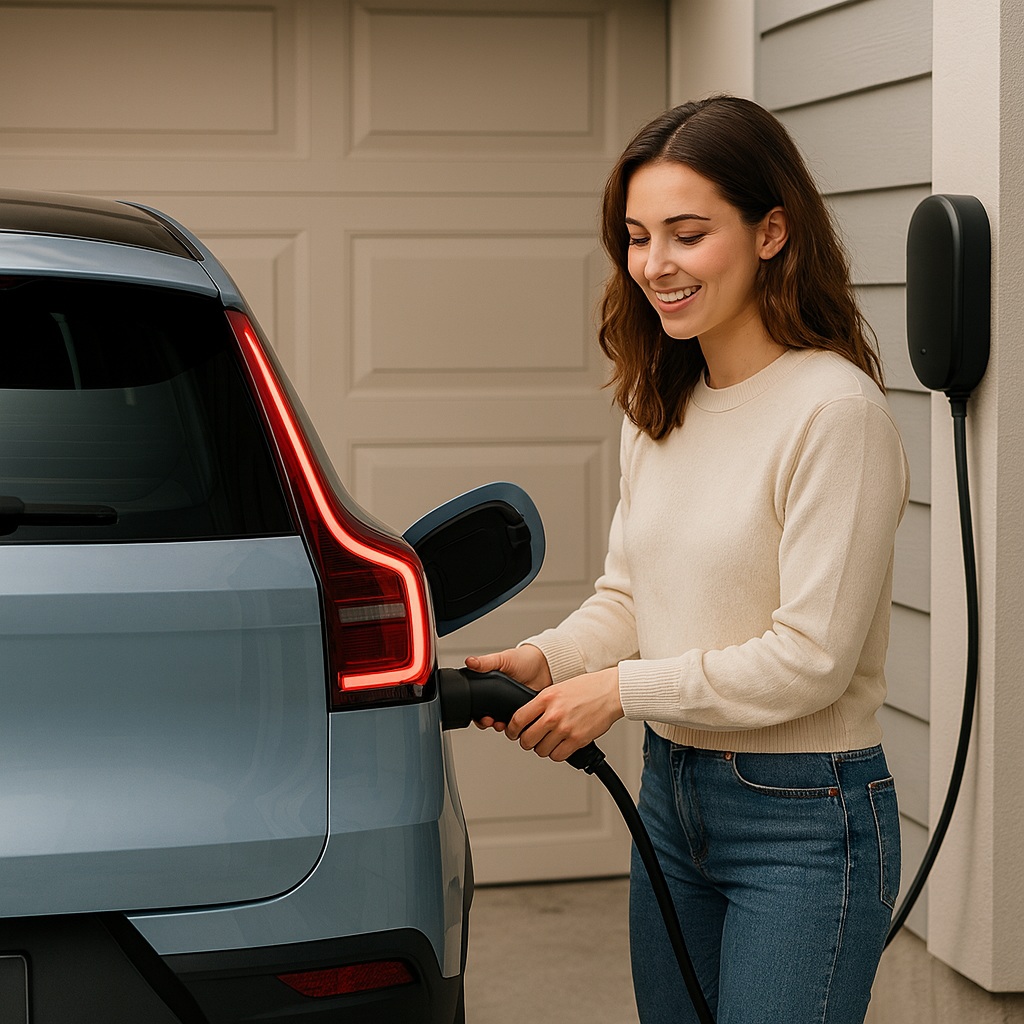
A car is normally parked at home for many hours. That gives a 3.6 kW or 7.4 kW single-phase wallbox, or an 11 kW three-phase wallbox, enough time to replace normal daily energy use. The equipment is smaller and the required supply is far more realistic for a residence than a DC fast charger.
The wallbox still performs important safety and control functions. It communicates the available current to the vehicle, controls energisation and can add scheduling, access control, energy records, solar control or load management. It does not force power into the battery.
Why DC charging can be much faster
A DC charger contains substantial conversion hardware and communicates directly with the vehicle’s battery-management system. By bypassing the car’s relatively small onboard AC charger, it can deliver tens or hundreds of kilowatts when both the vehicle and station allow it.
That speed requires a suitable electrical supply, switchgear, protection, cooling, civil works, communications and often commercial energy planning. DC charging is therefore normally installed where vehicles need a short turnaround or where several drivers depend on a shared facility.
The advertised DC peak is not the average
A vehicle may advertise a 150 kW DC peak without holding 150 kW for the whole session. The battery accepts power along a charge curve. It may charge strongly at a low or moderate state of charge, then reduce power as the battery fills. Temperature, preconditioning, battery chemistry, the charger, cable limits and power sharing can all change the curve.
This is why manufacturers often quote an indicative 10% to 80% time. Charging from 80% to 100% can take disproportionately longer, and routinely waiting for 100% at a busy rapid charger may not be the quickest travel strategy.
AC and DC ratings must not be confused
A vehicle specification may list 11 kW AC and 150 kW DC. These are separate capabilities through different electrical paths. An 11 kW wallbox will not become a 150 kW charger, and a 22 kW AC wallbox will not overcome an 11 kW onboard charger.
Connector names tell only part of the story
Type 2 is the common AC connector for modern vehicles in South Africa. CCS2 adds two large DC contacts below the Type 2 interface, allowing the vehicle inlet to support both Type 2 AC and CCS2 DC charging.
A connector that physically fits does not confirm the maximum power, phase support or charger compatibility. Check the exact vehicle derivative and charging-station specification.
Is DC charging harmful to the battery
The vehicle controls what the battery accepts and protects it within its programmed limits. DC fast charging is a normal supported function on equipped vehicles. Battery ageing depends on many factors, including temperature, time at very high or low state of charge, charging rate and the manufacturer’s thermal and battery management. Follow the vehicle maker’s guidance rather than treating every DC session as harmful or every charging habit as consequence-free.
Where each option makes sense
| Situation | Usually the practical option | Reason |
|---|---|---|
| Home overnight charging | AC wallbox | Long parking time and manageable supply |
| Office or shopping destination | AC or moderate-power DC | Choice depends on dwell time and vehicle turnover |
| Highway or route stop | DC fast charging | Shorter dwell time |
| Dealership preparation | AC plus DC where required | AC for routine charging; DC for rapid turnaround and testing |
| Fleet depot | Managed AC, DC or a mix | Duty cycle, return time and site capacity decide |
Choosing between them is an energy planning decision
For a home, the useful comparison is normally between AC charger sizes. For a business, start with how much energy each vehicle needs, when it arrives, when it must leave and how many vehicles charge together. A well-managed AC system can be more economical than unnecessary DC capacity. DC becomes valuable where turnaround time genuinely has a commercial value.
Talk to NevGridSolutions
We can help assess whether a home, workplace, dealership or fleet needs AC charging, DC charging or a managed combination. The recommendation starts with vehicles, dwell time and site capacity.
065 556 4000 | info@nevgridsolutions.co.za | www.nevgridsolutions.co.za
Frequently asked questions
Can I install a DC fast charger at home
It is technically possible in specialised cases, but the supply, cost and equipment usually make AC charging far more practical for a home.
Does CCS2 also support AC charging
A CCS2 vehicle inlet combines the Type 2 AC interface with additional DC contacts. AC charging uses the Type 2 portion; DC charging uses the additional contacts and associated communication.
Why does DC charging slow down near 80 percent
The vehicle follows a battery charge curve and normally reduces power as state of charge rises or conditions require it.
Is a 22 kW charger DC
Not necessarily. A 22 kW wallbox is commonly an AC charger. AC or DC describes the output to the vehicle, not simply the power rating.
Which is cheaper to install
AC equipment is normally much less costly and easier to supply. DC stations require substantial conversion equipment and a stronger supporting installation.
Talk to NevGridSolutions
NevGridSolutions can assess your vehicle, site, supply capacity, DB, solar or inverter system and installation route before recommending the hardware.